AI at Work is a weekly newsletter on how marketing teams redesign workflows, roles, and systems with AI. Real examples, practical frameworks, and repeatable processes operators can use immediately. Join thousands of successful marketing leaders by subscribing below!
Share
The Marketing Skill AI Can't Replace
Published 2 months ago • 7 min read
Hello Reader
When I led marketing at an events company, content was the most time-consuming part of my job and the hardest to get right.
Our niche took real work to understand, and no external writer we hired ever fully caught the tone we needed.
Content creation was the largest line item in my budget.
I was never willing to trade quality for quantity, and proving that the quality was worth the spend was a tough fight. My CEO wanted the same leads and the same revenue for less spend.
Today you can generate a hundred blog posts before lunch. You can fill a content calendar in an afternoon. None of that tells you whether the content deserves to exist or whether it will influence a buyer.
Given all the backlash against AI slop, I'll go out on a limb and say no.
Which means you’re still in a tough spot.
You need to produce content at volume, it needs to sound on-brand and authentic, and you need it to influence your target audience, all at half the cost.
So how are you going to manage that?
In this week's edition I'll walk you through how and when to use AI for content creation while staying true to your brand.
The Pressure to do More with Less
If you're leading a marketing team today, your CFO is probably asking some version of this question.
"If AI can create content in seconds, why are we spending so much on content?"
It's fair of him or her to ask.
Teams are saving real money.
Michael Babyak, GM of Revenue Operations at Poppy Flowers, told Digiday his team saves about $10,000 a month in agency fees by using Claude and Gemini's Nano Banana to produce content.
Ryan Close, founder and CEO of Bartesian, says AI now handles roughly 80% of the early creative work. His team tests messaging, imagery and creative concepts before an agency becomes involved.
Those are meaningful savings. They also explain why marketing budgets are under pressure.
When executives see examples like these, they start looking for the same efficiencies inside their own teams.
The mistake comes when lower production costs become the only goal.
Ryan is clear about where his team draws the line. AI helps generate ideas and explore creative directions, but his team owns the storytelling and final production.
The teams getting the most from AI focus on removing repetitive work so they can spend more time making editorial decisions, developing campaigns and understanding their audience.
The Cost of AI Slop
AI usage in advertising continues to rise but there’s a pretty big gap in opinions.
More than 80% of ad executives believe consumers feel positive about AI-generated ads, but only 45% of consumers actually feel that way and negative sentiment is on the rise (it’s up 12pts since 2024).
I bet there are many marketers who regret launching AI generated campaigns without thinking about it first.
The internet is littered with examples.
McDonald's Netherlands pulled its AI-generated holiday ad, “The Most Terrible Time of the Year,” last season after viewers called it “AI slop” and said it ruined their sense of the holiday.
Coca-Cola tried an AI remake of its “Holidays Are Coming” ad two years running, and both versions got called soulless and creepy, with delivery trucks that visibly changed shape mid-scene.
Vogue ran a Guess ad built using an AI-generated model, with a footnote disclosing the AI. Readers were outraged that a magazine built on decades of editorial photography published something so brazenly AI. The label made no difference to how people felt about it.
When AI Content Works
That’s not to say all AI generated content is terrible or badly received.
Take the Kalshi ads for example.
Audiences love them.
Kalshi’s NBA Finals ad was made by filmmaker PJ Accetturo using Google's Veo 3 and garnered more than 3 million views on X and got praised instead of mocked.
The deciding factor was human judgment.
Accetturo leaned into the strangeness of AI video instead of hiding it, and built the ad around a key idea: people doing outlandish things and the odds for or against them (Kalshi is an exchange for trading on real-world event outcomes).
The strangeness became the reason people watched and shared it.
You and your team need to know which of twenty on-strategy drafts will move a skeptical buyer, what your audience will roll its eyes at and when to avoid a brand fail like South Korea’s Starbucks.
Train Your Team for Judgement
Most AI training focuses on prompts.
I think that's a mistake.
Your team can learn prompting in an afternoon. Good judgment takes years to develop, and it has become far more valuable now that everyone has access to the same models.
Holly Enneking, VP of Marketing, Markup AI says she see a lot teams making a similar mistake. "Their first instinct is to feed a draft into Claude and say 'rewrite this in my brand voice,' but that throws away every good sentence along with the bad ones."
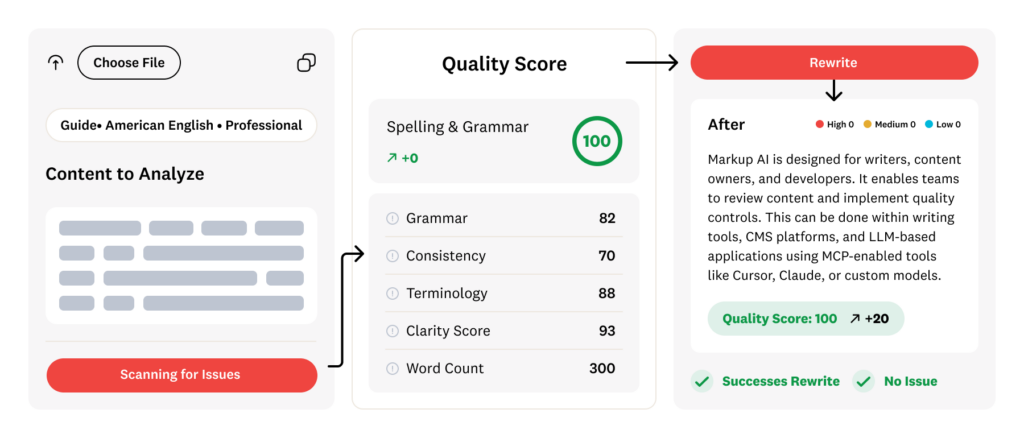
At Markup AI, they've designed AI agents to work alongside the humans in very specific ways.
"Our Content Guardian Agents don't rewrite; they review," Holly says. "They flag issues at the phrase, sentence, and paragraph level— this line doesn't sound like us, this paragraph won't surface in an AI Overview, this sentence reads like a robot wrote it — and leave the judgment call to a human."
Markup AI Content Agents at work
Her point: this is the difference between an agent that replaces editorial thinking and one that speeds it up.
"We don't lose the good work already in the draft," she says. "And I get to spend my judgment where it actually matters instead of re-reading a wholesale rewrite to figure out what changed and if it's any good."
Keeping Your Cognition
Ethan Mollick describes a habit he calls "cognitive surrender." People receive a convincing answer from AI and accept it without questioning it.
In studies of consultants, programmers and students, the people who stayed engaged with their work made better decisions than those who accepted AI's first answer.
If you want to stop cognitive surrender on your team, push them to ask more thoughtful questions.
Ones like:
Would one of our customers say this?
Does this sound like us?
Would our sales team believe this claim?
What evidence supports this point?
What important objection have we ignored?
Would I put my name on this?
Those questions build judgment.
AI can’t answer them because they depend on customer knowledge, market experience and brand context.
When I train marketing teams, I spend less time teaching prompts and more time teaching review. I want people to challenge the output, rewrite weak sections and reject ideas that feel generic.
Judgment functions as the primary gatekeeper of your brand's equity, rather than serving as a production bottleneck.
Talking to Your Boss
Sooner or later someone is going to ask why you still need writers, designers or agencies when AI can produce content in seconds.
If your CEO wants more content, agree on what "more" means.
Is it twice as many blog posts?
More social content?
Faster campaign launches?
Fewer agency hours?
Then change the conversation from cost to outcomes.
Take a piece of content you're currently working on and create two versions: one written by your star copywriter and one generated entirely by an AI tool.
Present both to your CEO without revealing which is which.
Ask them to identify which one will resonate with your prospects, and protects your brand voice. The difference in quality usually becomes obvious the moment they read them side-by-side.
If you have the time, launch a pilot test running human generated content against an AI-generated contender. Measure production time, cost, engagement and pipeline contribution. Compare your existing process with one that uses AI in the early stages and people in the final review.
It's hard for your CFO to argue with real metrics.
AI should help you produce more content for less money.
Your team should help the business produce better results.
Those are two different goals, and the second one is the reason your marketing team exists.
Build Judgment Into Your Workflows
One of the most useful frameworks I've found for working with AI comes from Anthropic. They call it the Description-Discernment Loop, and it gives teams a repeatable way to produce stronger work.
The process has three steps.
1. Description
Before asking AI to create anything, define what success looks like. Describe the output you need, how AI should approach the task and how you want it to work with you.
A prompt like:
Write a LinkedIn post about our new product.
produces a very different result from:
Write a LinkedIn post for IT leaders evaluating enterprise software. Use customer language, support every claim with evidence and point out any weaknesses in the argument. Use the attached template for the output.
2. Discernment
Now it’s time to judge the quality of the output. Apply this on three levels:
Product: Evaluate the output itself
Process: Assess how Claude approached the task
Performance: Consider if the AI’s behavior is helpful for what you need
The goal is to exercise your judgement muscle.
3. Refine
Now it’s time to integrate your own expertise and experience:
Provide feedback on what worked and what didn't
Clarify or adjust your description as needed
Add your unique perspective, creativity, or domain knowledge
Make the final decisions about what to keep, modify, or discard
Take responsibility for the final output
If you follow this framework, you'll have a team that knows how to work with AI, without sacrificing the essential parts they need to bring to the process.
Competitive research that takes half a day. A content brief that goes through three rounds before it works. Design assets that bounce between your team and the agency.
On July 23, we are running a 90-minute Masterclass and showing the whole system live.
I cover configuration, research and strategy. Toyah takes the brief through her design framework and builds the finished assets.
AI at Work subscribers get $100 off with code NEWSLETTER. Code expires July 17.
AI at Work is a weekly newsletter on how marketing teams redesign workflows, roles, and systems with AI. Real examples, practical frameworks, and repeatable processes operators can use immediately. Join thousands of successful marketing leaders by subscribing below!
Hello Reader You’ve been meaning to set up AI correctly. Then a campaign needs approving, a client asks for changes and three meetings appear on your calendar. The setup gets pushed to next week while you continue dragging work through the same collection of chats, files and tools. You may already have several useful pieces. A Project containing your brand documents or a prompt that produces a decent brief. Maybe you even have an agent with a name and job title. But every task still begins...
Hello Reader, A recent post in r/marketing collected dozens of AI-generated posters from different companies. Same blocky type, painted illustrations and crowded layout, even when the companies had nothing in common. At the start of this week the post had 932 upvotes and 250 comments. People had opinions. Some defended the posters as an effective way for small organizations to make something presentable. Others said they’d started scrolling past the style because every poster looked the same....
Hello Reader “Sorry we couldn’t find time to chat.” That sounds like a reasonable email to send a prospect who failed to schedule a meeting. Except this prospect had never received a meeting link. The email came from Zapier and landed in the inbox of a qualified enterprise buyer. The company’s automation blamed the buyer for failing to complete an action they’d never been given the chance to take. Angela Ferrante, who led enterprise marketing at Zapier (and is now head of marketing at...